Before two souls ever meet each other, the universe exists in a state of intentional pairs where the vastness of the heavens finds its balance in the grounding of the earth, and the brilliance of the sun finds its rest in the silver glow of the moon. In Islam, marriage is envisioned as a strong covenant, mithaqan ghaliza, that transcends a simple social contract, blooming instead into a sacred sanctuary of mawaddah and rahmah

To understand the beauty of marriage in Islam, one must first look at the profound wisdom behind our creation. Allah (SWT) did not place us on this earth to walk in solitude or to carry the burdens of the soul in isolation; rather, He (SWT) created us with an innate, restless yearning for companionship that only a kindred spirit can instill. This is why, even after creating the first man, prophet, and khalifah to walk this earth, Allah (SWT) had to create for Prophet Adam (as) a companion that would bring peace and comfort to his heart, especially with the trials that he was yet to face.
Allah (SWT) says in The Quran, “And one of His signs is that He created for you spouses from among yourselves so that you may find comfort in them. And He has placed between you compassion and mercy. Surely in this are signs for people who reflect.” (The Clear Quran®, 30:21)

As Muslims, we must learn and understand that a spouse is not a stranger, but a “garment” for the soul. He or she is a source of warmth in the cold, a shield against the hardships of the world, and a mirror that reflects your best self back to you. Marriage is a relationship rooted in the most delicate of balances where a simple act of kindness becomes an act of worship, and where the mundane struggles of daily life are transformed into a shared path toward Paradise. The true elegance of this union lies in its ability to turn two separate lives into a single, unified strength, proving that, when two people come together for the sake of their Creator, their love becomes a fortress of peace in an otherwise chaotic world.
Because marriage is given this importance in Islam, the marriages of the Prophet (SAW) have always drawn careful attention from Muslim scholars. His life was observed closely by his companions, and his home was one of the places where many of the most important lessons of Islam were learned. The Prophet (SAW) taught publicly in the mosque, but much of his character was also seen in his private life, like in how he (SAW) spoke to his family, showed kindness, listened, worshipped, and dealt with the ordinary moments that shape daily life. For this reason, the Prophet’s (SAW) marriages are not studied simply as personal events in his biography. They help explain how Islam was lived in its earliest form. Through the women of his household, many details of worship, family life, and legal guidance were preserved that would otherwise have remained unknown. Some of the most important narrations in the hadith literature came through those who lived closest to him and witnessed what others could not.
This is especially true in the case of Lady Ayesha bint Abu Bakr (ra). Her name appears throughout hadith, law, theology, and early Muslim scholarship with remarkable force. She narrated thousands of reports, corrected senior companions, answered legal questions, and became one of the most influential voices of the first generation of Islam. Long after the Prophet’s (SAW) death, scholars, judges, and students returned to her not simply because she had witnessed history, but because she understood it with unusual depth.

At the same time, this marriage is often discussed today through modern assumptions that differ greatly from the social world in which it took place.
A fair reading, therefore, requires more than isolating one narration or applying present-day expectations to a seventh-century society. This article will discuss what marriage meant in the Prophet’s (SAW) world, why this marriage took place in its own social setting, how the Prophet (SAW) conducted himself within it, and why Lady Ayesha bint Abu Bakr (ra) became one of the most important transmitters of Islam to later generations.
What did marriage and its expectations look like during the time of the Prophet (SAW) in 624 CE?
Marriage has never been understood in exactly the same way across all times and societies. The expectations attached to it, when people were considered ready, what counted as maturity, how family responsibilities were shared, etc., have always reflected the social world in which people lived. In premodern societies, where life expectancy was shorter and responsibility often began earlier, marriage commonly took place within norms very different from those familiar today. What seems unusual in one century may have been entirely ordinary in another. This was true not only in Arabia, but across much of the ancient and medieval world (Byzantine, Persian, Jewish, Christian, and later European societies).
Historical records from neighboring civilizations show that ideas about adulthood and readiness for marriage were shaped less by a fixed numerical age and more by physical maturity, family custom, and social circumstance.
Allah (SWT) says in The Quran, “Test ˹the competence of˺ the orphans until they reach a marriageable age. Then if you feel they are capable of sound judgment, return their wealth to them.” (The Clear Quran®, 4:6)

Classical scholars therefore understood marriage through a wider lens that included maturity, welfare, and readiness rather than reducing it to one measure alone. This context matters because the marriages of the Prophet Muhammad (SAW) took place within that historical world, yet they are remembered for more than their historical setting. For Muslims, these marriages are studied not simply because they happened, but because through them, important parts of the Sunnah were preserved for later generations.
The marriage of the Prophet (SAW) with Lady Ayesha bint Abu Bakr (ra)
When the Prophet (SAW) married Lady Ayesha bint Abu Bakr (ra), the Muslim community was passing through one of the most formative periods of its history. The early years after revelation had already brought persecution in Makkah, migration, and the gradual shaping of a new community whose relationships were bound not only by faith, but by trust, sacrifice, and shared struggle. In that setting, marriages often carried social meaning beyond the household itself, strengthening ties between families whose commitment to Islam had already become inseparable from the survival of the community. Lady Ayesha bint Abu Bakr (ra) was the daughter of Abu Bakr as-Siddiq (ra), the Prophet’s (SAW) closest companion, earliest adult supporter, and the one who stood beside him at the most critical moments of the Makkan period and during the Hijrah.
The closeness between the two households was already well established before the marriage itself. Later Muslim scholars often noted that this marriage deepened a bond that was already among the strongest in the Prophet’s (SAW) life, linking companionship in public mission with kinship in family life. The earliest hadith sources record that the marriage contract was concluded before the migration to Madinah, while the marriage was consummated later, after the Prophet (SAW) had settled there. Lady Ayesha bint Abu Bakr (ra) narrates in a well-known hadith, “the Prophet married [me] when [I] was six years old and he consummated his marriage when [I] was nine years old.” (Sahih Bukhari)
Historical reports show that this marriage was received naturally within the community of that time. Neither allies nor opponents of the Prophet (SAW) treated it as unusual, even though his opponents criticized him intensely on many other matters. Had it stood outside the accepted norms of the society in which they lived, it would almost certainly have appeared among the accusations preserved by early historians. Its absence from those criticisms is itself part of the historical picture.
What did their marriage look like?
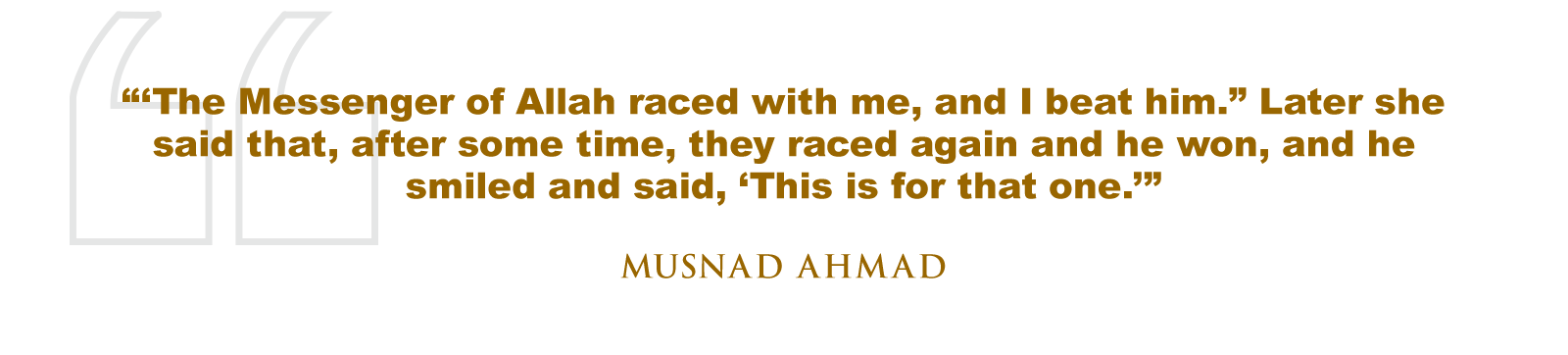
The marriage of the Prophet (SAW) and Lady Ayesha bint Abu Bakr (ra) is often discussed in historical terms, yet the hadith literature gives a much fuller picture. Their marriage was one marked by affection, attentiveness, and ease in daily life. What appears in these reports is not a distant or formal household, but one in which warmth and familiarity were clearly present. Among the most frequently cited examples is the well-known narration in which Lady Ayesha (ra) describes traveling with the Prophet (SAW) and racing with him. She said, “‘The Messenger of Allah raced with me, and I beat him.” Later she said that, after some time, they raced again and he won, and he smiled and said, ‘This is for that one.’” (Musnad Ahmad)
The narration captures something striking—playful companionship in a marriage often remembered only through formal historical reports. The Prophet (SAW) made room for joy, humor, and lightness, even while carrying immense public responsibility. Lady Ayesha bint Abu Bakr (ra) also described moments in which the Prophet (SAW) gave full attention to what interested her personally. During one Eid, Abyssinians were performing with spears in the mosque, and she wished to watch. She narrates that the Prophet (SAW) stood with her while she watched, and she learned against him until she herself decided she had seen enough.
Lady Ayesha bint Abu Bakr (ra) narrates, “He stood for me until I was the one who became tired.” (Sahih Bukhari)

The significance of the report lies not only in permission to watch, but in patience. He (SAW) remained standing simply because she wished to continue watching. Even in ordinary household moments, Lady Ayesha bint Abu Bakr (ra) noticed gestures of affection that later scholars often cited when discussing marital kindness. She said, “I would drink while menstruating, then hand the vessel to the Prophet, and he would place his mouth where mind had been and drink.” (Sahih Muslim)

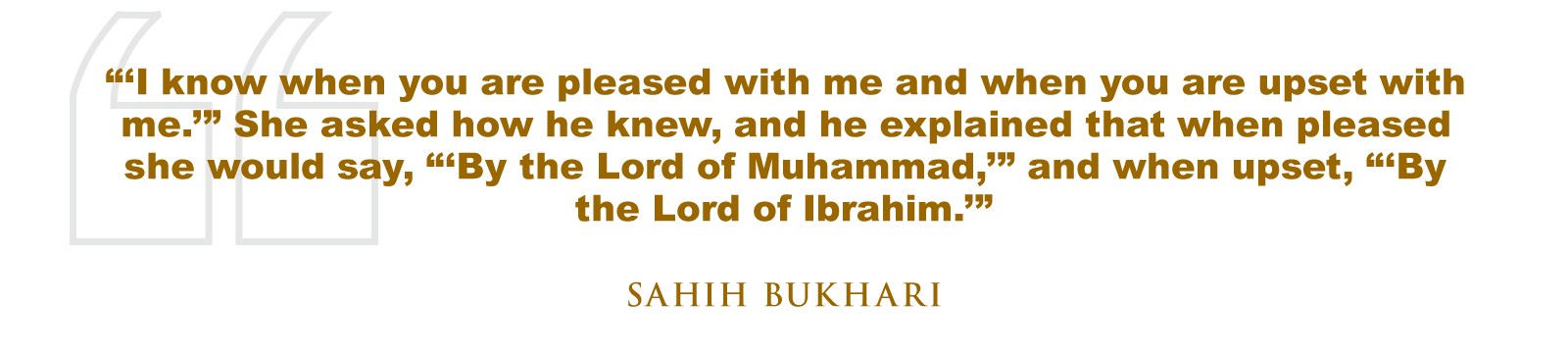
In another narration, she mentioned sharing food in the same way. These small reports became important because they revealed tenderness in actions that required no public display, only closeness and comfort. The Prophet (SAW) was also attentive to her emotions. He (SAW) once said to her, “‘I know when you are pleased with me and when you are upset with me.’” She asked how he knew, and he explained that when pleased she would say, “‘By the Lord of Muhammad,’” and when upset, “‘By the Lord of Ibrahim.’” (Sahih Bukhari)
At the same time, theirs was also a marriage shaped by worship. Lady Ayesha bint Abu Bakr (ra) narrates some of the most detailed reports about the Prophet’s (SAW) night prayers, his recitation, and his devotion in the final hours of the night. She saw the private consistency of worship that public life could not fully reveal and, through her, these moments became part of how Muslims understand spiritual discipline within married life itself.
Lady Ayesha bint Abu Bakr’s (ra) place in the Prophet’s (SAW) household and the weight of her scholarship
The closeness between the Prophet (SAW) and Lady Ayesha bint Abu Bakr (ra) was not hidden from those around them. The companions observed that she occupied a special place within the Prophet’s (SAW) household, not because affection in itself was unusual, but because that affection existed alongside intellectual trust and openness in conversation. When asked directly who among people was most beloved to him, the Prophet (SAW) replied, “Ayesha.” (Sahih

In the men, the most beloved to the Prophet (SAW) was her father. This report is often quoted because it shows how naturally the Prophet (SAW) spoke of love within family life. At the same time, that closeness did not mean the household was free of ordinary human emotion. Lady Ayesha bint Abu Bakr (ra) herself narrated moments of jealousy, especially when the Prophet (SAW) spoke of Lady Khadijah bint Khuwaylid (ra) with deep loyalty long after her death.
She once said that she had not felt jealousy toward any of the Prophet’s (SAW) wives as strongly as she felt it regarding Lady Khadijah bint Khuwaylid (ra), despite never having met her but because of how often the Prophet (SAW) remembered her.
After the Prophet’s (SAW) death, the full weight of Lady Ayesha bint Abu Bakr (ra)’s scholarship became unmistakable. She narrated more than 2,000 ahadith and became one of the most important legal authorities of the first generation. Senior companions would consult her on questions of inheritance, worship, purification, and family law. At times, she corrected narrations when she believed context had been missed, showing not only memory but analytical precision. Al-Zuhri has famously said, “If the knowledge of Ayesha were gathered and compared with the knowledge of all other women, her knowledge would surpass them.”

The final days of the Prophet (SAW) in her room
Among the clearest signs of Lady Ayesha bint Abu Bakr’s (ra) place in the Prophet’s (SAW) life is that his final illness unfolded largely in her room, and that he (SAW) spent his last earthly moments there. As his condition became more severe, he (SAW) asked permission from his other wives to remain in the room of Lady Ayesha bint Abu Bakr (ra) during the days of his illness. They agreed, and he (SAW) was brought there supported by two men, weakened by fever but still conscious of fairness even in pain. The detail itself reflects something central to his character that even in illness, he (SAW) did not assume privilege where rights were involved.
Lady Ayesha bint Abu Bakr (ra) later narrated those days with remarkable memory. She described how the Prophet (SAW) would continue asking about prayer, how he (SAW) instructed that Abu Bakr as-Siddiq (ra) lead the people, and how the room became the quiet center of the Muslim community’s most painful final hours.
The home that had witnessed ordinary moments of marriage now became the place where revelation’s earthly companionship was nearing its end. One of the most intimate reports from that day concerns the siwak. Lady Ayesha bint Abu Bakr (ra) said that her brother Abd al-Rahman entered carrying a tooth-stick while the Prophet (SAW) was resting against her. She noticed him looking toward it and understood that he (SAW) wanted it. She took the siwak, softened it for him, and placed it in his hand, “I softened it for him, and he brushed his teeth with it in the best way I had seen him use a siwak.” (Sahih Bukhari)

Eventually, the Prophet (SAW) passed between the neck and head of Lady Ayesha bint Abu Bakr (ra). Her room would also become the place of his burial. In accordance with the prophetic principle that prophets are buried where they leave this world, he (SAW) was buried there, in the same room that held years of worship, conversation, teaching, and companionship.
A Prophetic reminder for the Ummah on marriage
When the life of the Prophet Muhammad (SAW) is studied through his marriages, one lesson appears again and again: marriage is not sustained by rights alone, but by character. The legal framework of marriage is important, but what gives that framework life is the way spouses speak, listen, forgive, and remain gentle with one another in ordinary moments. Much of what Lady Ayesha bint Au Bakr (ra) preserved about the Prophet (SAW) was not grand advice delivered publicly, but daily acts that showed how faith enters the home. The Prophet (SAW) said, “The best of you are those who are best to their families, and I am the best of you to my family.” (Sunah at-Tirmidhi)

This hadith places a person’s true character not in public reputation, but in private conduct. A person may appear generous, disciplined, or respected outside the home, yet the Prophet (SAW) taught that goodness is tested most honestly where patience is repeatedly required – with those who live closest to us. His marriage to Lady Ayesha bint Abu Bakr (ra) shows that affection should not be neglected in the name of seriousness. He (SAW) smiled, listened, waited, joked, and gave attention to what mattered to her. He (SAW) noticed her moods, allowed emotion to be expressed, and did not treat tenderness as weakness. In many homes, hardship does not begin because love disappears, but because kindness becomes rare in daily interaction. The Sunnah teaches us that mercy is often carried in small things such as tone of voice, time given, restraint in anger, and the willingness to make room for another person’s feelings.

At the same time, Lady Ayesha bint Abu Bakr (ra) teaches us that marriage should also be a place where faith and growth continue. She did not remain only a witness to the Prophet’s (SAW) life, she became one of the greatest scholars of Islam. A righteous marriage should help both people become better before Allah (SWT). One should become more thoughtful, more patient, more grounded in worship, and more beneficial to others.

In a time when marriage is often burdened by unrealistic expectations or weakened by impatience, the household of the Prophet (SAW) reminds believers that tranquility is built slowly through mercy, restraint, trust, and the intention to please Allah (SWT) before winning every argument. A home may be small, as the room of Lady Ayesha bint Abu Bakr (ra) was small, yet if it holds faith, mercy, and remembrance of Allah (SWT), it can become larger in meaning than any space built only with comfort.
Duas
O Allah (SWT)! Grant those who are seeking marriage spouses who will be a source of peace for their hearts, strength for their faith, and goodness for their future.
O Allah (SWT)! May You bless them with righteous companionship, protect them from disappointment and harm, and open for them what is best at the time that is best.
O Allah (SWT)! Place barakah in their waiting, wisdom in their choices, and mercy in what You decree for them, and make their future homes places of love, remembrance, and tranquility.
Ameen!